
 PomoZentra
Know what share of the week reached paid work.
Client work always feels urgent and sales never does, right up until the month the pipeline is empty. PomoZentra makes you commit blocks to both, then tells you at the end of each day how much of the week genuinely reached the work that pays.
Free. No credit card required, and no paid plan.
Your week, as it actually runs
Your income is a function of how much of the week reaches billable work, and almost nothing in your day protects that. Client requests arrive with implied deadlines. Sales is the one thing with no external pressure behind it, so it is the first thing to go in a busy fortnight, and the busy fortnight is exactly when next month's pipeline is being decided. You probably already track hours for invoicing. That tells you what to bill. It does not tell you that outreach got one block in eleven days.
The one question this answers
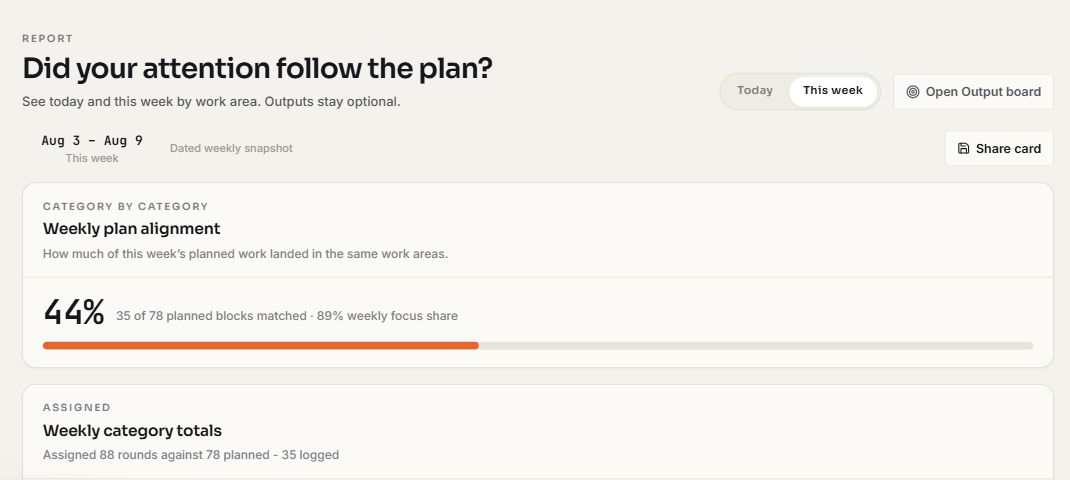
Of the blocks you planned for each area this week, how many did your attention actually reach? Everything else on this page is in service of that.
What keeps going wrong
Four patterns specific to freelancers. If none of these are familiar, this is probably not the tool for you.
Sales dies exactly when you are busiest
The weeks with the most client work are the weeks with no outreach, which is what produces the quiet month six weeks later. The cause and the effect are too far apart to feel connected.
Unbillable work is invisible
Proposals, scoping calls, revisions that were never in scope, admin. Real hours that no invoice reflects and no tracker separates from the rest.
Feast and famine feels like luck
It usually is not. It is a repeating pattern of dropped outreach during delivery, which only becomes obvious when you can see the weeks side by side.
Time tracked is not time that counted
A tracker measures the hour whether it moved the project forward or went into a revision you should have pushed back on.
What changes
Stated as what becomes visible, not as a percentage improvement we have not measured on your work.
The parts that matter for freelancers
The product has more in it than this. These are the four that earn their place in your week.
Weekly focus share on Sales and Client work
Of everything you logged, the proportion that reached the two areas your income depends on. Not a guess reconstructed on Friday.
Sales scored on its own line
Credit is capped per area, so a heavy delivery week cannot disguise a week with no outreach in it. The quiet pipeline is visible while you can still act.
Optional output targets
If minutes are not the unit, add proposals sent or calls booked with a weekly target. The daily number calibrates from your own goal, so one proposal a day can be a full day.
Honest partial credit
The block where you moved the deliverable but did not ship it counts as half. Most freelance work is exactly that shape.
What you would actually use it for
- Hold one non-negotiable sales block every day, even in a delivery crunch
- See the real billable share of a week before you quote the next project
- Catch the revision spiral where one client quietly takes three days
- Check whether a retainer is actually worth its hours
- Decide whether to raise rates using your own weeks rather than a feeling
Where it sits in your week
Five minutes on Monday, one tap per block, two minutes on Wednesday.
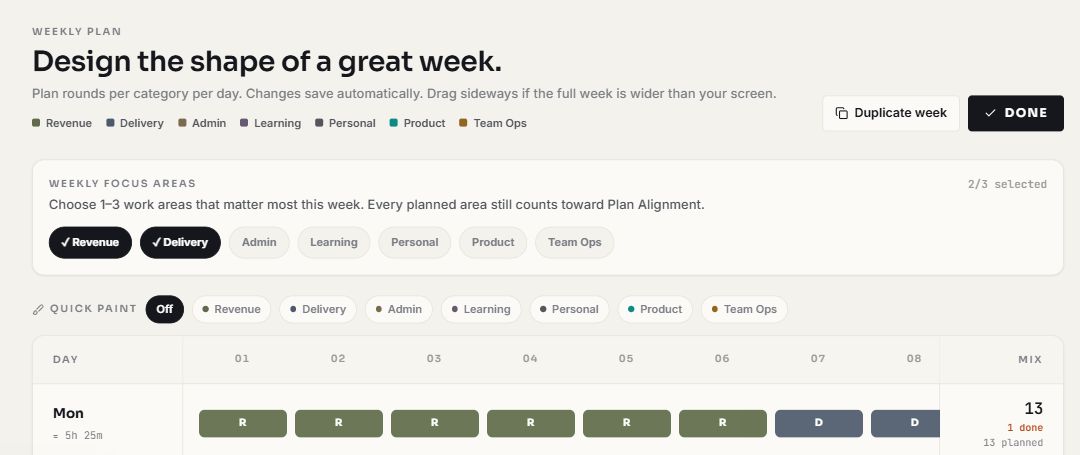
- MONDAYMark Sales and Client work as this week's focus. Plan a small daily sales block and the client blocks around it.
- EVERY BLOCKRun the timer, pick the area, answer whether it moved forward. Log a proposal sent if you track outputs.
- WEDNESDAYCheck focus share. If Sales is at zero, move a block before the week is gone.
- FRIDAYCompare planned against actual. A week that repeatedly overruns on one client is a scoping problem, not an effort problem.
What it looks like
Current product views show the decision before the week and the comparison after focus has been logged.
Compared with how you work now
Not competitors, methods. Most freelancers are using one of these.
A worked freelancer week
Focus areas Sales and Client work, six blocks a day. The plan holds one Sales block every single day rather than a single large weekly session. By Wednesday two Sales blocks have run instead of three, and Client work is one ahead. The Client surplus is capped, so it does not disguise the Sales gap, and Thursday gets the missing block added back. Weekly focus share lands at 78 percent, meaning roughly one block in five went somewhere neither area needed.
An illustration worked through the real scoring rules, not customer data.
What we cannot show you yet
No testimonials, no case studies and no user counts. PomoZentra is new, and inventing social proof would undo the one thing this product is built on. What you can check instead: the scoring formula is published in full on the method page, and the timer runs without an account, so you can put one real week through it and judge the number yourself.
When there are freelancers willing to be quoted, they will appear here with their name and their permission, not as an anonymous claim.
The tools you already use
Nothing is connected
There are no integrations and no public API. PomoZentra does not read your calendar, your task manager or your inbox, and nothing is pulled in automatically. Google is used for sign-in and nothing else.
What that means in practice
Your existing tools stay exactly where they are. This sits beside them and asks for one tap at the end of each block. If you need it to sync with your stack, it is the wrong tool and there is no roadmap that changes that soon.
Questions from freelancers
Does it track billable hours or produce invoices?
No. There is no rate, no client record and no invoice. Keep your time tracker for billing. This answers a different question: what share of the week reached paid work at all.
Can I track per client?
Not really, and that is a genuine limit. Work areas are types of work, not clients. If per-client reporting is what you need, a time tracker is the right tool.
I bill hourly. Is this useful to me?
Yes, alongside your tracker rather than instead of it. Hourly billing makes the billable share question more important, not less.
What if a client emergency destroys the plan?
Log what actually happened, including the unplanned work. A pattern of the same client repeatedly detonating your week is itself the finding.
Can I export for my accountant?
You can export everything as CSV or JSON at any time, but it is focus data rather than financial data. It is not built for accounting.
See the calculation. Then shape it around your week.
Move from the core method to one practical starting point, or check the product facts before you begin.
Plan one week and see.
Five minutes on Monday is the whole commitment. By Wednesday afternoon you will know something about your week that you did not know before.